 Castle Tours Europe
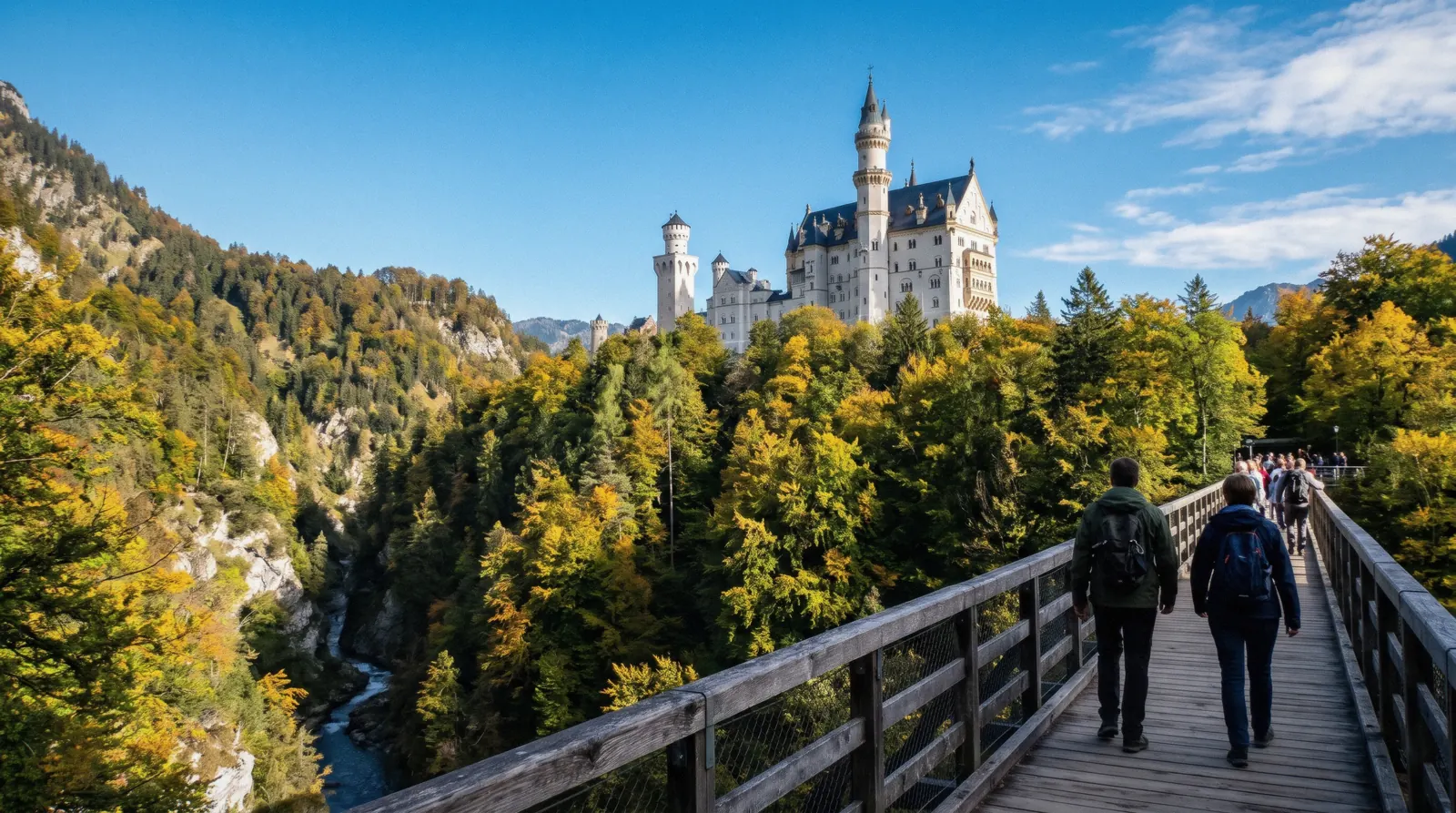
Neuschwanstein Castle is the hilltop palace King Ludwig II of Bavaria built above the village of Hohenschwangau, and it is the most photographed of the castles in Germany. Every visit runs on a timed ticket and a 30-minute interior tour, and summer slots sell out. This guide helps you pick between the day trips from Munich and visiting on your own, and explains the walk, the viewpoint and the timing. For the full shortlist, see the castle tours in Europe.
Quick answer Neuschwanstein in short
Neuschwanstein is a Neo-Romanesque palace built for King Ludwig II between 1869 and 1892 above Hohenschwangau in Bavaria. Entry is by timed guided or audio-guided tour of about 30 minutes covering 14 rooms, and the classic view is from the Marienbrücke bridge. Book ahead: up to 6,000 people a day visit in summer and the closest larger town is Füssen.
Key takeaways
- Book the skip-the-line ticket with audio guide if you are already in the Allgäu, or the full-day trip from Munich covering Neuschwanstein and Linderhof if you are coming from the city.
- Pair it with Hohenschwangau Castle, Ludwig's childhood home in the village below, or with Linderhof Palace, the only palace he lived in.
- Arrive in the village 1.5 to 2 hours before your entry time, the official advice, since you still walk up to the gate.
- For context, compare it with Wartburg's influence, other fairytale castles or Bavaria's fortress at Salzburg.
Key facts
Opening hours
| 28 March to 15 October | 09:00–18:00 |
|---|---|
| 16 October to 27 March | 10:00–16:00 |
Closed 1 January and 24, 25 and 31 December
Planning it
- Time needed
- Our estimate: half a day for the castle, the bridge and Hohenschwangau village, a full day if coming from Munich
- Book ahead
- Optional — walk-up usually fine
- Address
- Neuschwansteinstraße 20, 87645 Schwangau, Germany
Neuschwanstein castle tickets: which option fits you
The table compares the bookable ways to see Neuschwanstein Castle: two coach and train day trips from Munich, two more Munich days built around Linderhof and the train, and the skip-the-line entry ticket for travellers already in the Allgäu. Prices, lengths and what is included come straight from each offer.
Where are you starting from, and do you want Linderhof and a guide as well as the castle?
| Option | Price | Length | Includes | Book |
|---|---|---|---|---|
| From Munich: Neuschwanstein & Linderhof Castle Full-Day TripMunich visitors who want both of Ludwig's palaces in one coach day | from $85 | 10 - 10.5 hours | Coach from Munich with a guide, castle tickets only on the option that includes them | Check Availability |
| Neuschwanstein Castle and Linderhof Palace Day Trip from MunichTravellers who want the highest-rated day and do not mind a long coach ride | from $82.20 | 10.5 hours | Linderhof Palace, Oberammergau from the bus, audio guide inside Neuschwanstein, admission on the option with entry | Check Availability |
| From Munich: Neuschwanstein Castle Full-Day TripVisitors who prefer the train, a smaller radius and time at Marienbrücke | from $89 | 10 hours | Guided regional train day to Füssen with lunch, castle entry optional at about €24 paid on the morning | Check Availability |
| Neuschwanstein Castle Tour from MunichVisitors who want a guaranteed reserved castle time on a small-group train day | from $90.20 | 10 hours | Guided train trip, reserved tour time, Mary's Bridge stop when weather allows, entry of €24 paid at check-in | Check Availability |
| Neuschwanstein Castle Skip-the-Line Ticket with Audio GuideTravellers already in Füssen or the Allgäu who just need the timed entry | from $50 | 1 hour | Timed entry and audio guide, collected in Füssen, transport and castle parking not included | Check Availability |
On the day trips without entry included, the castle ticket of $23.50 (€21) is paid on top. Figures current in Q4 2026.
All Neuschwanstein Castle tours and tickets
Every bookable option for Neuschwanstein is listed here, from full Munich day trips to the entry ticket on its own.
 from $85
Most reviewed
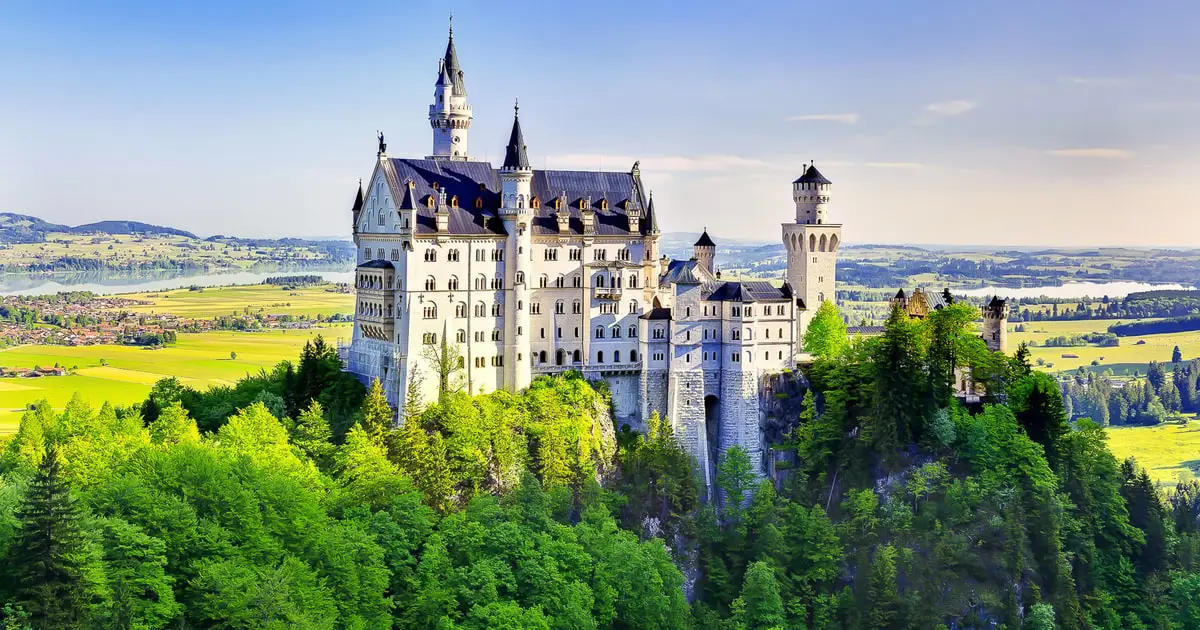
From Munich: Neuschwanstein & Linderhof Castle Full-Day Trip
Coach from Munich to both of Ludwig II's palaces in one day, with a guide and optional timed castle tickets.
Check Availability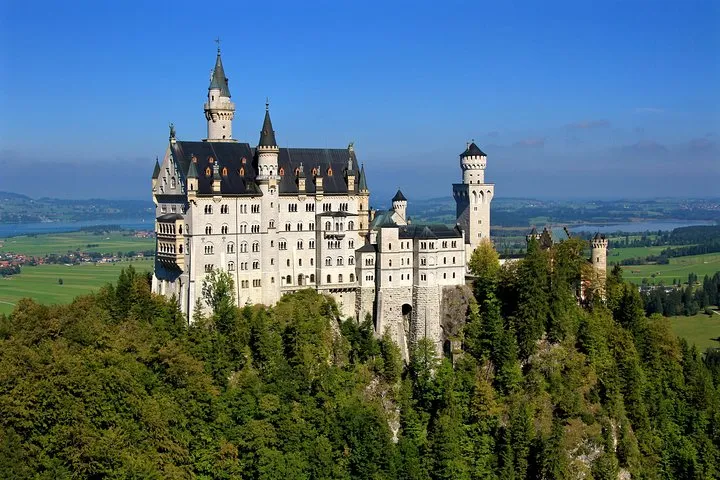 from $82.20
Top rated on Viator
Neuschwanstein Castle and Linderhof Palace Day Trip from Munich
Coach day from Karlsplatz to Linderhof Palace, Oberammergau and Neuschwanstein with an audio guide inside the castle.
Check Availability from $89
Train, not coach
From Munich: Neuschwanstein Castle Full-Day Trip
A guided day by regional train from Munich to Füssen, then up to Neuschwanstein with time at Marienbrücke.
Check Availability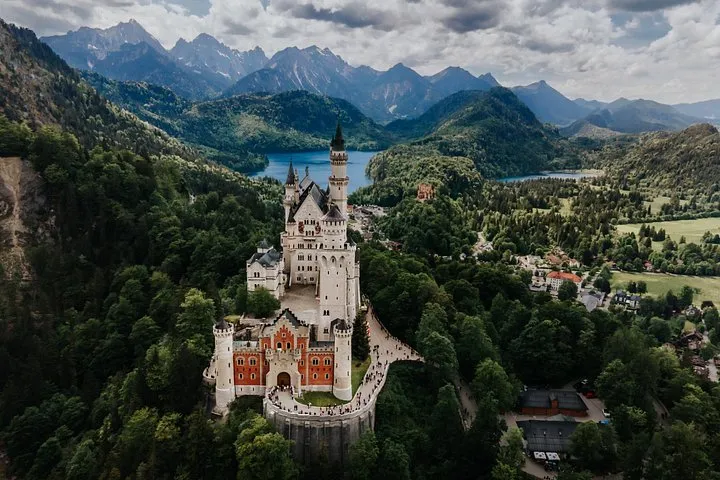 from $90.20
Entry guaranteed
Neuschwanstein Castle Tour from Munich
A guided train trip from Munich with a reserved Neuschwanstein tour time and a stop at Mary's Bridge when the weather allows.
Check Availability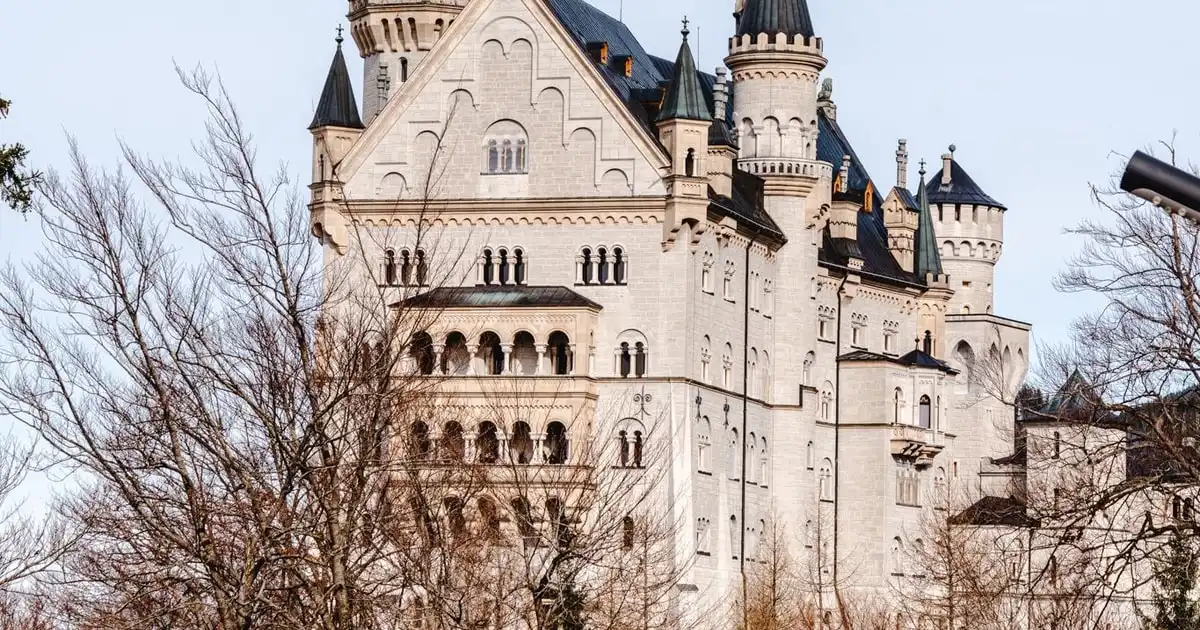 from $50
Ticket only
Neuschwanstein Castle Skip-the-Line Ticket with Audio Guide
A timed entry to Neuschwanstein with an audio guide, collected in Füssen, for travellers already in the Allgäu.
Check AvailabilityPrices, ratings and details are the platform's own. dollar figures are the listed prices — the platform bills in your account's currency.
What Neuschwanstein Castle is and why it matters
A short orientation before you book: what this palace actually is and what makes it different from a medieval fortress.
A 19th-century fantasy, not a fortress
Neuschwanstein is a 19th-century historicist palace on a rugged hill in the foothills of the Alps, in the municipality of Schwangau in Bavaria, close to the Austrian border. Ludwig II of Bavaria commissioned it in 1869 as a private retreat and as a tribute to the composer Richard Wagner. The three-winged complex was built between 1869 and 1892 to plans by Eduard Riedel, with a stage designer, Christian Jank, drafting the look. The style is Neo-Romanesque, and the model was medieval knights' castles rather than defensive architecture.
Two journeys shaped it: Ludwig visited the Wartburg near Eisenach in May 1867, the setting of Wagner's Tannhäuser, and the Château de Pierrefonds in July 1867, which Viollet-le-Duc was rebuilding for Napoleon III. The Singers' Hall echoes the Wartburg's contest hall. At 65 metres, Guinness World Records lists it as the tallest castle in the world, and since 2025 it has been part of a UNESCO World Heritage Site covering Ludwig's palaces.
The practical consequence: you are booking a timed 30-minute interior tour, not a free roam. Only 14 rooms were finished, and the throne room, bedroom and minstrels' hall are the highlights. For a different flavour of German castle, the real medieval ruins of Eltz Castle or the Heidelberg Castle桶 barrel town are the common alternatives.
- Built 1869 to 1892, Neo-Romanesque, architect Eduard Riedel
- Commissioned by Ludwig II as a retreat and a Wagner tribute
- Opened to the public shortly after his death in 1886
- More than 61 million visitors since, over 1.3 million a year
What you see, in walking order
A visit runs uphill through the village, past the viewpoint, through 14 rooms and back down. Here is the sequence.
From the village gate to the throne room and back
You start in Hohenschwangau village, where the Ticket Center on Alpseestraße 12 handles tickets from 08:00 and the two castles sit on facing hills. The official advice is to arrive 1.5 to 2 hours before your Neuschwanstein entry time, because you still need to get up the hill. On foot the ascent is a steady climb that most visitors find moderately difficult, roughly the effort of a long stairway hike. Horse-drawn carriages and a shuttle bus operate as alternatives, and rucksacks, prams and child carriers are not allowed inside.
Before or after the tour, the Marienbrücke bridge spans the Pöllat gorge above the castle and gives the classic postcard view from the back, with the hillside dropping away beneath it. In winter the bridge can close in icy conditions, so treat it as a bonus rather than a promise.
Inside, the 30-minute tour shows 14 rooms in a fixed sequence. The throne room, with its Byzantine-inspired design, the bedroom and the minstrels' hall are the rooms guides single out. The throne itself was never installed. Photography inside is not permitted, which is why the official interior images look the way they do, so plan your picture-taking for the outside terraces and the bridge.
Afterwards, walk down to see Hohenschwangau Castle across the valley, Maximilian II's neo-Gothic palace where Ludwig grew up among frescoes of the Lohengrin legends that later fed his building plans. Many day trips build in exactly this rhythm: village, bridge, tour, then the lower palace before the ride home.
| Stop | What it is | Time to allow |
|---|---|---|
| Hohenschwangau village and Ticket Center | Ticket collection, cafes, start of all routes | 30 to 60 minutes, our estimate |
| Ascent to the castle gate | Steady uphill walk, or carriage or shuttle | 45 minutes on foot, our estimate |
| Marienbrücke | Bridge over the Pöllat gorge with the classic rear view | 20 to 30 minutes, our estimate |
| Interior guided or audio tour | 14 rooms in about 30 minutes, timed entry | 30 minutes, fixed |
How difficult is the walk up
The climb from the village to the castle gate is the main physical demand of the day. It is a paved but continuously rising path through the woods, and visitors who walk rarely describe it as technical, only as a sustained uphill effort. Allow close to three-quarters of an hour at a relaxed pace, in our estimate, and more if you stop.
The horse-drawn carriages cover part of the route and the shuttle bus shortens it further, so the walk is manageable for most people with ordinary fitness. Inside the castle there are stairs between rooms, and the tour keeps to a timetable, so late arrivals lose their slot. Wear shoes with grip, especially after rain, and note that the Marienbrücke adds its own stepped approach from the path.
Hours, tickets and the quiet times
The castle runs on two seasonal timetables and a hard closure list. Build your day around the entry time, not around opening time.
Opening hours and closures
From 28 March to 15 October the castle opens 09:00 to 18:00. From 16 October to 27 March it opens 10:00 to 16:00. It closes on 1 January and on 24, 25 and 31 December. Every visit is a guided or audio-guided tour of about 30 minutes with a timed entry, and late arrivals lose the tour, so the entry time on your ticket is the number that matters.
The Ticket Center in Hohenschwangau village at Alpseestraße 12 sells same-day tickets only, from 08:00, and they are limited. In high season they are often gone by late morning. Online booking carries a fee of $2.80 (€2.50) per ticket, which also applies to free under-18 tickets, since children need a ticket even though entry is free. Hohenschwangau Castle, the palace below, costs $26.30 (€23.50) for adults, and the Museum of the Bavarian Kings in the village charges $16.23 (€14.50).
Crowds peak between late morning and early afternoon in summer, when daily visits can reach 6,000. The quietest windows, on our estimate, are the first entry slots of the day and the last ones before closing. If you would rather let someone else hold the timing, the Munich day trip with a reserved castle time locks your slot in advance.
Getting there from Munich and the Allgäu
Neuschwanstein sits above Hohenschwangau village, and the closest larger town is Füssen. Most visitors arrive on a coach or a train from Munich.
The routes that actually get used
From Munich the two realistic options are coach and rail. The coach days, such as the Gray Line trip to Neuschwanstein and Linderhof, meet at Sonnenstraße 3 in the centre and take you door to door with a guide. The train days travel by regional train from Munich to Füssen, the closest larger town, then continue up to the castle, which is how the Radius Tours full-day trip and its reserved-time variant run. Füssen sits at 47.56667, 10.7, and the castle at 47.5576, 10.7498, a short onward hop by bus or taxi from the station.
If you are already in the Allgäu, you do not need a transfer at all. Collect the skip-the-line ticket with audio guide at Bahnhofstraße 12 in Füssen and make your own way to Hohenschwangau. Parking at the castle lots costs extra on that plan.
Driving yourself is straightforward by German standards: the village lies south of Füssen on the Alpine foreland, with signposted car parks below the castles. The squeeze point is the same whichever route you take, because everyone funnels through Hohenschwangau village and its ticket system, so the 1.5 to 2 hour buffer before your entry time exists for a reason. For other easy castle days from Munich, Salzburg's fortress sits on the same rail corridor and Linderhof Palace pairs with Neuschwanstein on the coach days.
| Routing | How it works | Best for |
|---|---|---|
| Coach day from Munich | Guided coach from central Munich, often adding Linderhof Palace and Oberammergau | First-time visitors who want everything arranged |
| Train day from Munich | Regional train to Füssen with a guide, then up to the village | Travellers who dislike long coach stretches |
| Self-organised from the Allgäu | Own transport to Hohenschwangau, timed ticket collected in Füssen | Anyone already staying near Füssen or the lakes |
How much time to give it
Half a day covers the castle properly if you are already nearby: the walk up, the bridge, the 30-minute tour and a look at Hohenschwangau Castle below. In our estimate, plan four to five hours on site if you add the lower palace or the museum. Coming from Munich, the day is effectively fixed at ten to ten and a half hours by coach or train, which is what all the Munich day trips run to, and that includes travel both ways.
Do not try to compress Munich to castle to a second sight in the village into less, because the timed entry and the official arrival buffer leave little slack.
Neuschwanstein Castle timeline
From a medieval fortress ruin to a UNESCO listing, the dates that explain what you are looking at.
-
12th century
The Schwangau fortress
A fortress of the lords of Schwangau, ministeriales of the Welfs, stood on the rock where Neuschwanstein now rises, and the minnesinger Hiltbolt von Schwangau lived in that era.
-
1832 to 1837
Hohenschwangau Castle rebuilt
Crown prince Maximilian II bought the ruin of Schwanstein in 1832 and rebuilt it as a neo-Gothic palace, his family's summer residence, where young Ludwig spent much of his childhood among Lohengrin frescoes.
-
1859
Ludwig sketches the ruin
The crown prince first sketched the ruined castles above his family's palace in his diary.
-
1864
Ludwig becomes king
Ludwig II ascended the Bavarian throne at 18 and made a new palace on the ruin site his first building project, naming it New Hohenschwangau Castle.
-
1867
The Wartburg and Pierrefonds journeys
Visits in May to the Wartburg and in July to the Château de Pierrefonds gave Ludwig his models for a Romantic interpretation of the Middle Ages.
-
1868
The letter to Wagner
In May 1868 Ludwig wrote to Richard Wagner of his intention to rebuild the old castle ruin of Hohenschwangau in the style of the old German knights' castles.
-
1869 to 1892
Construction
The three-winged palace was built to plans by Eduard Riedel in the Neo-Romanesque style, funded by Ludwig's personal fortune and extensive borrowing rather than state funds.
-
1886
Death of Ludwig II and public opening
Deposed on 12 June and found dead the next day, Ludwig never saw the palace finished, and it opened to the public shortly after his death, later taking the name Neuschwanstein.
Sources: the castle's own history as summarised on Wikipedia and the Ludwig II biographical record.
Do and do not at Neuschwanstein
Do
- Book your timed entry in advance, because same-day tickets at the Ticket Center are limited and often gone by late morning in high season
- Arrive in Hohenschwangau village 1.5 to 2 hours before your entry time, the official advice
- Leave rucksacks, prams and child carriers behind, since none of them are allowed inside
- Allow about 45 minutes, our estimate, for the uphill walk, or plan for the carriage or shuttle
- Walk on to Marienbrücke for the classic rear view while the weather holds
- Pair the visit with Hohenschwangau Castle below, where Ludwig grew up
Don't
- Do not arrive late to your slot, because late arrivals lose the 30-minute tour
- Do not photograph inside, interior photography is not permitted
- Do not bring a rucksack, pram or child carrier inside, they are not allowed in the palace
- Do not count on the Ticket Center as a fallback in summer, same-day tickets are limited
- Do not underestimate the climb, the path rises steadily from the village
- Do not plan a tight onward schedule, the whole day funnels through one village and one entry system
Five things most visitors do not know
Small facts that change how you look at the palace.
The details behind the facade
Most visitors know the silhouette. These five points are the ones that make the interior tour and the history click.
- Ludwig funded the palace from his personal fortune and by extensive borrowing, not from Bavarian public funds, and his ministers eventually used the spending against him to declare him insane, a determination now questioned Wikipedia: Ludwig II of Bavaria.
- The palace was originally called New Hohenschwangau Castle and only got the name Neuschwanstein after Ludwig's death, which effectively made Hohenschwangau and Schwanstein swap names Wikipedia: Neuschwanstein Castle.
- At 65 metres, Guinness World Records lists Neuschwanstein as the tallest castle in the world, a 19th-century palace beating genuine medieval keeps Wikipedia: Neuschwanstein Castle.
- The Singers' Hall was planned with a view of the castle in the background and the courtyard as a nod to Lohengrin, a direct musical programme Ludwig spelled out in his 1868 letter to Wagner Wikipedia: Neuschwanstein Castle.
- Only about 14 rooms were finished, and the huge throne room never received its throne, since Ludwig died in 1886 before completion Wikipedia: Neuschwanstein Castle.
Neuschwanstein Castle on the map
The castle and the places that make up a visit, from the bridge to the surrounding palaces.
- 1 Neuschwanstein CastleLudwig II's Neo-Romanesque palace above Hohenschwangau, seen on a 30-minute timed interior tour.
- 2 MarienbrückeThe bridge over the Pöllat gorge that carries the classic rear view of the castle.
- 3 Hohenschwangau CastleMaximilian II's neo-Gothic palace where Ludwig spent his childhood, on the facing hill.
- 4 FüssenThe closest larger town and the railhead for the castle, where the skip-the-line tickets are collected.
- 5 Linderhof PalaceThe smallest of Ludwig's three palaces, the only one completed and lived in, paired with Neuschwanstein on coach days.
Numbers match the pins on the map.
Near Neuschwanstein
Three places worth adding to a castle day in this corner of Bavaria.
Hohenschwangau Castle
Ludwig II's childhood home, rebuilt by his father Maximilian II between 1833 and 1837 with frescoes of the Lohengrin legends that shaped the young king. Adult entry is $26.30 (€23.50), and seeing both palaces in one day is the classic pairing.
A short walk across the village, our estimate Read the guideLinderhof Palace
The smallest of Ludwig's three palaces and the only one he completed and lived in, designed in the style of the second rococo period and inspired by Versailles. Both the Gray Line day trip and the Mentor Reisen day combine it with Neuschwanstein.
A coach ride east into the Graswang valley Read the guideFüssen
The closest larger town, the railhead for visitors arriving by train and the collection point for the skip-the-line castle ticket. It also anchors the wider region of castles in Germany.
A short bus ride from the village, our estimate Read the guideNeuschwanstein Castle questions
What is so special about Neuschwanstein Castle?
It is a 19th-century Neo-Romanesque palace built for Ludwig II as a Wagner-inspired fantasy of a medieval knights' castle, perched above a gorge in the Bavarian Alps. Its location, itsunfinished interiors and its fairy-tale silhouette made it the model for castle imagery worldwide, and more than 61 million people have visited since it opened to the public.
Which German city is closest to Neuschwanstein Castle?
The closest larger town is Füssen in Bavaria, and the castle itself stands above the village of Hohenschwangau in the municipality of Schwangau. Most visitors come from Munich, which is the base for the full-day Neuschwanstein trips by coach and by regional train.
Why can't you take pictures in Neuschwanstein?
Photography inside is not permitted, which is why the castle's own images are professionally produced. You are free to photograph as much as you like outside, on the terraces and from the Marienbrücke, so plan your camera time for before and after the 30-minute interior tour.
How difficult is the walk up to Neuschwanstein Castle?
The path from Hohenschwangau village climbs steadily through the woods for about 45 minutes at a relaxed pace, in our estimate. It is paved but continuously uphill, so most visitors find it tiring rather than difficult. A horse-drawn carriage and a shuttle shorten the climb if you would rather save your legs.
Do you need to book Neuschwanstein castle tickets in advance?
Yes, in practice. Entry is timed and same-day tickets at the Ticket Center are limited, often gone by late morning in high season when visits reach 6,000 a day. The skip-the-line ticket with audio guide locks your slot, and the Munich day trips with entry included guarantee the castle time.
How long is the Neuschwanstein castle tour?
Every visit is a guided or audio-guided tour of about 30 minutes covering 14 rooms, including the throne room, bedroom and minstrels' hall. Late arrivals lose their slot, and the official advice is to be in the village 1.5 to 2 hours before your entry time.
Can you see Neuschwanstein and Hohenschwangau Castle in one day?
Yes, and many do. The two palaces face each other across the village. Hohenschwangau Castle, Ludwig's childhood home, costs $26.30 (€23.50) for adults, so book both timed entries with enough gap for the walk between them, in our estimate four to five hours on site in total.
Is Neuschwanstein worth it if you cannot do the interior tour?
The silhouette and the Marienbrücke view are the famous part and cost nothing to enjoy from outside, but the 14-room tour is where the Wagner-themed rooms and the golden throne room make sense. If interiors are not your thing, a castle with open ruins such as Heidelberg Castle or Eltz Castle may suit you better.
Neuschwanstein Castle on film
Three short films that show Neuschwanstein Castle and the way in, worth a look before you pick a tour.
A New UNESCO Site! What Makes Neuschwanstein Castle so Fascinating?
Filmed by DW Travel: Neuschwanstein Castle as you will see it on the day.
Video: DW TravelNeuschwanstein - Fairytale castle and architectural icon | DW Documentary
Filmed by DW Documentary: Neuschwanstein Castle as you will see it on the day.
Video: DW DocumentaryNeuschwanstein Castle: Ultimate Visitor's Guide
Filmed by Cleared 2 Travel: Neuschwanstein Castle as you will see it on the day.
Video: Cleared 2 TravelPrices, hours and terms are set by the venue or operator and confirmed at checkout.
We may earn a commission if you book through one of our links, at no extra cost to you. Full affiliate disclosure